

Governance
Convictions and fines
Convictions
VSME B11
Were there any convictions for violations of legal regulations during the reporting period?
This question aims to disclose your company's overall legal compliance and provide transparency regarding serious legal misconduct. To answer, indicate whether there were any final convictions or fines imposed on your company during the reporting period.
Were there any convictions in the reporting year related to the following topics? If yes, use the response options and specify the number of convictions per category.
This question aims to disclose your company’s integrity and to clarify whether there were any final convictions for unfair business practices during the reporting period.
To answer, provide the number of convictions issued against your company or its legal representatives.
If there were no convictions during the reporting period, this question can be answered with “No.” The follow‑up questions related to convictions will then not be displayed.
|
Term |
Meaning |
|
Convictions |
If no convictions occurred during the reporting year, this question can be marked as “Not applicable for my company.” This will automatically hide follow‑up questions and mark them as completed. |
|
Fines |
Fines for violations of regulations on combating corruption and bribery refer to mandatory monetary penalties imposed by a court, an official body, or another public authority, which must be paid into a public treasury. |
|
Corruption |
Abuse of entrusted power for personal gain, which may be committed by individuals or organisations. This includes practices such as bribery, fraud, extortion, collusion, and money laundering. Corruption also includes offering or accepting gifts, loans, fees, rewards, or other advantages as an incentive to perform something dishonest, illegal, or in breach of trust in connection with company activities. |
|
Bribery |
Dishonestly persuading a person to act in someone’s favour by giving them a monetary gift or another incentive. |
Example
An employee in our procurement department receives a free repair of their private vintage car worth EUR 2,000 from a supplier.
In return, the employee awards the annual contract to this supplier, even though a competitor submitted a better and cheaper offer.
This constitutes private bribery, as the personal benefit influenced and distorted the business decision. This can lead to criminal consequences for all parties involved.
What remedial measures were taken after the conviction to address the identified issues?
This question aims to disclose which concrete steps your company has taken to eliminate the root causes of legal violations and prevent future misconduct.
To answer, describe whether internal policies were tightened, new control systems (such as a compliance management system) were introduced, or personnel measures were taken to restore the company’s integrity.
|
Term |
Meaning |
|
Convictions |
If no convictions occurred during the reporting period, this question can be marked as “Not applicable for my company,” which will automatically hide the sub‑questions and mark them as completed. |
Example
A company had a conviction during the reporting period. To fully address the incident and minimise future risks, the following measures were taken:
- Whistleblowing system: We introduced a confidential reporting channel allowing employees and external partners to report potential violations securely and anonymously if desired.
- Stricter internal controls: Procurement and approval processes were restructured and now strictly follow the four‑eyes principle, combined with mandatory documentation.
- Training programme: All managers and employees in sensitive areas (procurement, sales) completed mandatory training on anti‑corruption and responsible business conduct.
- Code of Conduct: A binding Code of Conduct was implemented, defining clear rules on handling gifts, invitations, and conflicts of interest.
What is the total amount of fines imposed during the reporting period due to violations of legal regulations on combating corruption and bribery?
This question aims to clarify the financial impact of legally binding sanctions for corruption or bribery on your company during the reporting period.
To answer, state the total amount of all fines and penalties in euros imposed on the company or its responsible bodies. Round the amount to two decimal places.
|
Term |
Meaning |
|
Corruption |
Abuse of entrusted power for personal gain, which may be committed by individuals or organisations. This includes practices such as bribery, fraud, extortion, collusion, and money laundering, as well as offering or accepting gifts, loans, fees, rewards, or other benefits as an incentive to act dishonestly or unlawfully. |
|
Bribery |
Dishonestly persuading a person to act in someone’s favour by giving them a monetary gift or another incentive. |
EU reference values
Exclusions in connection with Paris-aligned EU reference values
VSME C8
Does your company fall under any of the following categories which, according to Article 12(1) of Delegated Regulation (EU) 2020/1818, justify an exemption from EU Paris‑aligned benchmarks?
This question aims to determine whether your company falls under one of the categories defined in the EU regulation. For this purpose, the predefined company groups from Article 12 of Delegated Regulation (EU) 2020/1818 of the Commission of 17 July 2020 are used.
|
Term |
Meaning |
|
Article 12(1) |
Defines when companies are excluded from Paris‑aligned EU benchmarks. |
|
Note To answer, you must check whether you generate significant revenues in one of the four categories. Multiple selections for different reasons are possible. |
Revenue from certain activities
Revenue from business activities
VSME C8
Does your company generate revenues from any of the activities listed below?
This question aims to disclose whether the company generates revenues from the listed negative factors. This information is relevant to determine whether investments in the company can be classified as sustainable (see also (EU) 2022/1288, Annex I, Table 1).
|
Term |
Meaning |
|
Revenues |
include exploration, extraction, production, processing, storage, refining or distribution—including transport, storage and trading—of fossil fuels as defined in Article 2(62) of Regulation (EU) 2018/1999 of the European Parliament and of the Council. |
|
Note As soon as an activity is selected here, a free-text field will automatically open in which the revenue amount (in €) must be entered. |
Other revenue
VSME C8
Does your company generate revenues from any of the activities listed below?
This question aims to disclose whether the company generates revenues from the listed negative factors.
This information is relevant to assess whether investments in the company can be classified as sustainable (see also (EU) 2022/1288, Annex I, Table 1).
|
Note “Revenues from the manufacture of chemicals (pesticides and other agrochemical products)” Information in this section refers to activities covered under Regulation (EU) 2023/137, Annex, Section C, Division 20.2. These are: Manufacture of pest control products, plant protection products, and disinfectants; manufacture of pest control, plant protection, and disinfectant products. |
Animal welfare
Describe whether and to what extent your company's business activities are associated with risks or controversies in the area of animal welfare.
The purpose of this question is to assess whether the company’s activities, including actions involving animals or animal husbandry, meet a legally required minimum standard of animal welfare. This includes, among other things, compliance with legal requirements for housing, transport, the use of medications or other synthetic substances, slaughter conditions, etc.
|
Note The following five areas should be considered when answering this question:
|
Example
Our business activity as a food retailer is associated with animal welfare risks across the entire supply chain, particularly in primary production and transportation. To address these risks, we require our partners to comply with the “Five Freedoms” of animal welfare:
Freedom from hunger, thirst and discomfort: We require audited housing systems that ensure constant access to fresh water, appropriate feed, and dry, protected resting areas.
Health and behaviour: Regular veterinary stock inspections minimise the risk of illness and injury. Our standards for minimum space allowances and enrichment materials enable animals to express normal social and exploratory behaviours.
Fear and stress: Particular controversies arise in transport and slaughter. We minimise stress through strict time limits for transport routes and certified stunning procedures.
To date, no severe controversies have been reported in our operations; however, we are continuously working to increase our animal welfare labels (e.g. husbandry level 3 or 4) to further reduce inherent risks.
Gender diversity in the management body
Gender diversity
VSME C9
If your company has governance bodies, indicate the numerical gender ratio.
This question aims to provide transparency regarding gender diversity at the highest decision‑making levels of your company and to highlight progress in equal opportunities.
To answer, you must report the number of women, men and, where applicable, non‑binary individuals in your management or supervisory bodies (such as management board or executive board) as of the reporting date. Round the result to two decimal places.
|
Term |
Meaning |
|
Governance body |
The governance body is the highest decision‑making authority within a company. Depending on the legal framework applicable to the company and the classification of its legal entity, the structure of the governance body may vary. |
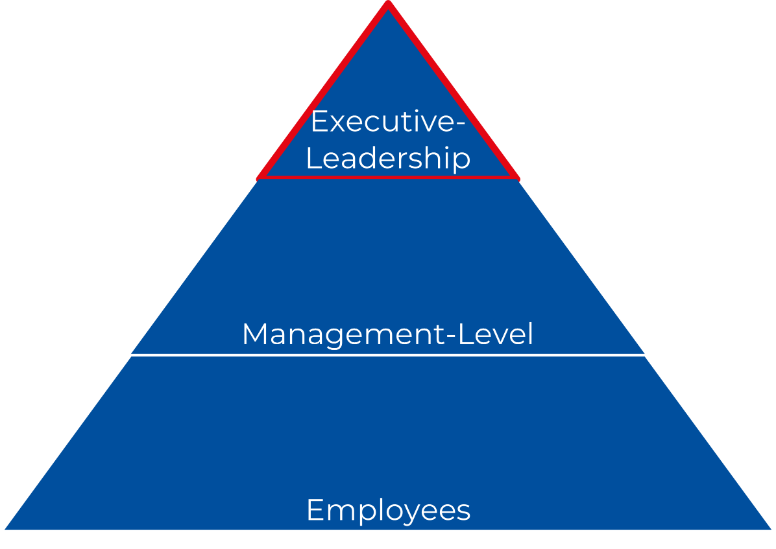
Pic.10: Executive Leadership
|
Note The difference to the question “Please state the ratio of women to men at management level during the reporting period”: Management level is considered to be the level below the executive-level. Hierarchically, the executive bodies are thus above the employees at management level. |
Calculation
| Number of female executive bodies |
| Number of male executive bodies |
For the calculation, headcounts are required — that is, the number of persons, not full‑time equivalents.
Examples
Example A
In a small limited liability company (GmbH), the most common legal form, the governance body is the Managing Director.
Mr Müller, the founder and majority shareholder of the small “Müller Landtechnik GmbH”, is usually the sole managing director. He makes all major decisions and represents the company in contractual matters.
Example B
In a larger stock corporation (AG), the governance body is the Executive Board.
“Alpenholz AG” has a multi‑member executive board, for example Dr Schmidt (Chairwoman of the Board) and Mr Gruber (Chief Production Officer). They share management responsibilities and are supervised by the supervisory board.
Gender diversity in the management body
Gender diversity
VSME C9
If your company has governance bodies, indicate the numerical gender ratio.
This question aims to provide transparency regarding gender diversity at the highest decision‑making levels of your company and to highlight progress in equal opportunities.
To answer, you must report the number of women, men and, where applicable, non‑binary individuals in your management or supervisory bodies (such as management board or executive board) as of the reporting date. Round the result to two decimal places.
|
Term |
Meaning |
|
Governance body |
The governance body is the highest decision‑making authority within a company. Depending on the legal framework applicable to the company and the classification of its legal entity, the structure of the governance body may vary. |
Other
Other information on governance
VSME
In addition to the requirements of this questionnaire, do you also collect company‑specific or sector‑specific sustainability information in the area of governance to enable more comprehensive and credible reporting?
If yes, you may use the free‑text field to provide these details.
This question is optional and may be answered with key figures and/or descriptive information. It can be marked with the option “Do not answer this question,” or answered with a short statement. The information provided should support the creation of relevant, accurate, comparable, understandable, and verifiable disclosures. This allows individual characteristics and values of the company to be highlighted.
Providing information in this section can help protect the company from accusations of greenwashing. Transparent disclosure of sustainability data may also provide a competitive advantage.
|
Term |
Meaning |
|
Company‑specific |
Information on sustainability aspects that are specific to the company. |
|
Sector‑specific |
Information on sustainability aspects that are common within the company’s sector. |
A detailed list with examples of sustainability aspects is provided in Annex A of this manual.
Examples
Example A
A bakery places great value on sourcing its raw materials (grain, eggs, …) locally. The company discloses that it has written agreements with its regional suppliers guaranteeing minimum prices above market average and payment terms of no more than 14 days. Such information provides insight into how the company ensures local, sustainable supply and fairness in its business practices.
Example B
In international B2B business, there is an increased risk of corruption or unclear business practices. The company discloses that it has a compliance policy limiting gifts and invitations (e.g., a €50 threshold), which is mandatory training for all employees annually.