

Social

Workforce
Temporary contracts
How many of your employees are currently employed on temporary contracts?
This question is intended to clarify the extent to which your company relies on time‑limited employment relationships, which provides insight into the continuity of employment.
To answer, you need the number of all employees whose employment relationship automatically ends due to a fixed calendar date or a specific purpose (e.g. project completion).
|
Term |
Number |
|
Temporary contracts |
Temporary contracts are characterized by the fact that, in addition to a start date, the employment relationship also has a defined end date. |
|
Note Further information on the topic of fixed‑term employment relationships can be found here (German only). |
How many of your employees are currently employed under permanent (open‑ended) contracts?
This question aims to show the stability of employment relationships in your company, as permanent contracts are considered an indicator of long‑term job security.
To answer, you need the number of all employees with an employment contract that has no fixed end date, based on the reporting period or a selected reference date.
Details regarding staff
VSME B8
Indicate the total number of employees in your company, broken down by gender.
This question aims to provide transparency regarding the basic composition of your workforce and to create the foundation for further indicators such as the gender ratio.
To answer, you need the current list of your employees, using either the headcount at the end of the reporting period or the average value calculated over the reporting period. Indicate the number of employees separated by women, men and – if collected – non‑binary/diverse persons as well as persons without stated gender.
If your company operates in more than one country, indicate how many employees are employed in each country.
If there are no employees in other countries, you may either include a note stating that the company operates only in one country and does not employ staff abroad, or mark the question as “Not applicable for my company”.
Pic 8: Do not answer question
Example
Country 1: 5 employees
Country 2: 10 employees
If your company has more than 50 employees, indicate the employee turnover rate for the reporting period in percent (%).
This question is intended to clarify how stable the workforce in your company is and whether there are indications of high employee dissatisfaction or structural issues.
To answer, you will need the number of employees who left the company during the reporting period—voluntarily or involuntarily—as well as the average total number of employees. Round the result to two decimal places.
|
Term |
Number |
|
Employee turnover |
Employee turnover refers to employees who leave the company voluntarily or due to dismissal, retirement, or a fatal workplace accident. |
Calculation
| Exits during the reporting period |
| (Employees at start of reporting period + employees at end of reporting period) × 0.5 |
Example
|
Reason for exit |
Number |
|
Retirement |
2 |
|
Dismissal |
2 |
|
Time period |
Number |
|
Start of reporting period |
37 |
|
End of reporting period |
33 |
| 2 + 2 |
| (37 + 33) × 0.5 |
The turnover rate in the company is 11.43%.
Details regarding staff
VSME B8
Indicate the total number of employees in your company, broken down by gender.
This question aims to provide transparency regarding the basic composition of your workforce and to create the foundation for further indicators such as the gender ratio.
To answer, you need the current list of your employees, using either the headcount at the end of the reporting period or the average value calculated over the reporting period. Indicate the number of employees separated by women, men and – if collected – non‑binary/diverse persons as well as persons without stated gender.
If your company operates in more than one country, indicate how many employees are employed in each country.
If there are no employees in other countries, you may either include a note stating that the company operates only in one country and does not employ staff abroad, or mark the question as “Not applicable for my company”.
Genderpaygap
VSME B10
Indicate the percentage pay gap between female and male employees.
The parameter for the percentage pay gap between female and male employees addresses the principle of gender equality, which requires equal pay for work of equal value. The pay gap is defined as the difference between the average pay level of female and male employees, expressed as a percentage of the average pay level of male employees. Round the result to two decimal places.
|
Term |
Definition |
|
Benefits in kind |
For example: company cars, private health insurance, life insurance and wellness programmes. |
|
Gross pay |
Depending on the company’s remuneration policy, gross remuneration refers to all of the following components: base salary (i.e. guaranteed, short‑term, fixed cash compensation); cash remuneration, i.e. the sum of base salary plus cash allowances, bonuses, commissions, profit‑sharing and other forms of variable cash payments; and benefits in kind. |
Calculation
| ⌀ Gross hourly pay of male employees – ⌀ Gross hourly pay of female employees |
| ⌀ Gross hourly pay of male employees |
|
Note All employees must be included when calculating this parameter. |
Example
Company A has a total of X male and Y female employees. The gross hourly pay of male employees is EUR 15 and the gross hourly pay of female employees is EUR 13.
The average gross hourly pay of male employees is calculated by dividing the sum of all gross hourly payments by the total number of male employees. The same applies to the calculation for female employees.
| 15 – 13 |
| 15 |
Minimum wage
Do employees receive pay that is equal or above applicable minimum wage that is determined directly by the national minimum wage law or through a collective bargaining agreement for the country your company reports in?
This question is intended to clarify whether your company ensures that no employee is paid below the salary level prescribed by law or collective agreement in order to guarantee fair working conditions.
To answer this question, you must compare the current payroll lists with the minimum salaries specified in the applicable collective agreement or (internationally) with the statutory minimum wage rates.
Collective agreements
VSME B10
Indicate the percentage of employees covered by collective bargaining agreements.
This question aims to determine the share of your workforce whose working conditions are protected by collective bargaining agreements (in Austria: “Kollektivverträge”), which is considered an indicator of social security and fair working conditions.
To answer, you need the total number of your employees as well as the number of those who fall under an industry‑specific collective agreement. Round the result to two decimal places.
Calculation
| Number of employees covered by collective bargaining agreements |
| Total number of employees |
The result should be rounded to two decimal places.
Calculate the ratio using headcount, not FTE (full‑time equivalents).
Example
An Austrian planning office employs 55 people. While 50 employees fall under the collective agreement for employees of chartered engineers, the 5 freelance contractors are not covered by this agreement. The company therefore states in its ESG report that approximately 91% of employees (50/55 × 100) are covered by collective bargaining agreements. Since in Austria nearly all dependent employees are covered through mandatory membership in the Economic Chamber and the corresponding negotiations of the social partners, this value is often close to 100% for SMEs.
Topics of continued education and advanced training
VSME B10
Indicate the average number of training and education hours by gender during the reporting period.
This question aims to make your company’s investment in the professional development of its workforce visible, as well as the level of equal opportunity in access to training measures.
To answer, you need the total number of completed training hours (internal and external), broken down by the gender of participants, as well as the average number of employees per gender group during the reporting period.
The collection of training and education hours can be carried out internally, for example through an Excel spreadsheet. It is important to record the date, topic and duration of each training.
Example
|
Gender |
Number |
Total hours |
Ø Calculated hours per employee |
|
female |
35 |
80 |
80/35 = ~2.5 h |
|
male |
26 |
40 |
40/26 = ~1.5 h |
|
non-binary |
4 |
6 |
6/4 = 1.5 h |
|
not specified |
1 |
2 |
2/1 = 2 h |
Gender Ratio
VSME C5
Indicate the ratio of women to men in management positions during the reporting period.
This question aims to clarify the extent to which leadership positions in your company are distributed in a gender‑balanced way, which is a key indicator of equal opportunities. Round the result to two decimal places.
|
Note The management level is considered the level below the governing/supervisory body, unless the company applies its own definition. |
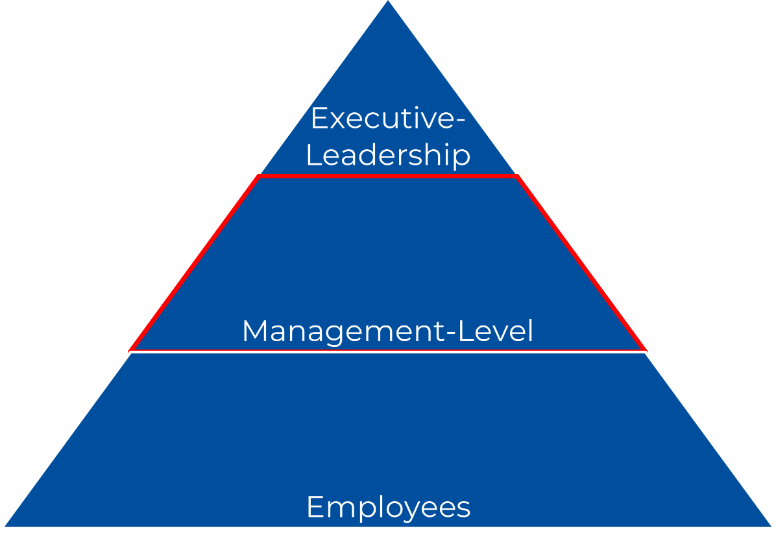
Pic. 9: Classification of level
Calculation
Ratio:
(women/men) × 100 = percentage value
Calculate the ratio using headcount and not FTE (full-time equivalents).
Example
In a company, 20 female and 80 male employees are employed at management level. The female-to-male ratio is therefore 25%. This means that there is one woman at management level for every three men.
Female-to-male ratio = 20 / 80 × 100 = 25%
Interpretation:
100% = equal representation
<100% = fewer women than men
>100% = more men than woman
| Note |
| This should not be confused with the percentage of women, which in this example would be 20%. |
|
Note If there are employees at the management level who identify as non-binary/diverse, they are not included in the calculation. They are considered “neutral” for the purpose of this metric. To still reflect the diversity within your company, the employee table on the “Employee Information” page in the Social section allows you to report non-binary employees in management positions. |
|
Term |
Meaning |
|
Non-binary/diverse person |
A non-binary person does not identify exclusively as male or exclusively as female, but somewhere on the gender spectrum between, outside, or beyond these two categories. |
Workforce characteristics
VSME C5
If your company has 50 or more employees, indicate the number of self-employed persons who work exclusively for your company and do not have their own personnel.
This question is optional. It aims to clarify the extent to which your company relies on “one‑person businesses” (OPBs) that function economically like internal staff but are legally self‑employed.
This question can be left unanswered if your company has fewer than 50 employees. The questionnaire can still be completed even if this question is not answered.
Example
An Austrian IT service company with 55 employees regularly works with two specialised programmers for software development. These programmers have no staff of their own, use their own equipment and dedicate 100% of their working time to this company’s projects. Since these individuals are integrated into the value creation process as external specialists, they must be reported in the statistics as “self‑employed persons without their own staff”. This also helps create transparency regarding employment structures and supports awareness of potential risks related to bogus self‑employment under Austrian social security law (ASVG).
If your company has 50 or more employees, indicate how many temporary agency workers provided by external companies are active in your organisation.
This question is also optional and can be skipped if your company has fewer than 50 employees. The questionnaire can still be completed even if this question is not answered.
This question serves to provide transparency on your company’s dependence on external labour and its relevance for operational processes.
To answer, you need the exact number of individuals who are integrated into your workflows but do not have a direct employment contract with your company and are instead supplied by temporary staffing agencies.
Example
An Austrian SME in the food production sector employs, on average, 65 permanent staff. Due to seasonal peaks (e.g. before public holidays), the company additionally requests 15 temporary workers through an agency to ensure production capacity. In its ESG report, the company must list these 15 temporary agency workers separately.
Legal conformity
Code of conduct
VSME C6
Does your company have a code of conduct or policies for respecting human rights for its own workforce?
This question aims to ensure that your company has established fundamental ethical standards to protect its own employees and actively implements them. To answer, you must indicate whether a written document exists.
Does your company have a code of conduct or policies for respecting human rights for its own workforce? If yes, are the following aspects covered:
This question aims to ensure that your company has defined binding internal rules that guarantee the protection and dignity of your employees with respect to the selected rights.
|
Note If your company does not yet have a code of conduct or corresponding policies, please answer this question with “No, no standards in place”, otherwise the follow-up question will not be displayed. |
Value chain
VSME C6
Does your company have a code of conduct or policies to ensure respect for human rights along the entire value chain?
This question aims to clarify whether your company has written principles in place that require the protection of human rights not only within its own operations but also from suppliers and business partners.
Example
An Austrian metal processing company sources components from various international suppliers. To minimize legal risks and meet ESG requirements, the SME has implemented a “Supplier Code of Conduct”, which is attached to every supply contract. In this document, the supplier commits, among other things, to complying with the prohibition of forced and child labor in accordance with the ILO core labor standards. If a random audit or a whistleblower report reveals that a subcontractor is violating these standards, the code of conduct foresees a joint improvement plan or, as a last resort, the termination of the business relationship.
Reporting system for whistleblowers
VSME C6
Does your company have a complaints-handling mechanism for its own workforce?
This question aims to determine whether a structured and confidential process exists through which employees can report misconduct without fearing negative consequences.
Such a process could be, for example, an anonymous whistleblowing system.
Example
An employee notices that overtime hours are systematically not recorded correctly. Since the SME has established a simple complaint procedure – such as a protected email inbox or a designated contact point in the HR department – she can report the issue. The company is then required to review the case confidentially and provide the employee with feedback on the actions taken within a reasonable time frame.
Human rights
Incidents in the company's own workforce
VSME C7
Have there been any confirmed incidents related to human rights among your company's workforce? If so, do the incidents relate to:
This question aims to clarify whether there were any legally or internally verified violations of fundamental human rights standards within your own workforce during the reporting period.
To complete the answer, you will need access to HR documentation, complaint management records, and information on concluded legal proceedings or administrative decisions.
|
Term |
Meaning |
|
Confirmed incident |
is present when either legal proceedings or a formal complaint has been filed with the company or a competent authority, or when the company has identified a violation through its established procedures. Such procedures may include audits, formal monitoring programmes, or complaint mechanisms. |
Examples
Example A
An employee was systematically passed over for promotion due to their ethnic origin. After an internal complaint and subsequent investigation by the equal oppurtunities office, the case was officially confirmed as discrimination.
Example B
Another example would be when safety standards in a factory were not followed, and an audit by an occupational safety authority documented this as a serious violation of workers’ health protection.
Describe the measures your company has taken to remedy the reported incidents.
This question may be skipped if no confirmed incidents related to human rights occurred.
Example
An internal audit confirmed that the production facility repeatedly required short-term but unpaid forced work (unauthorised, unpaid overtime under threat of dismissal).
Remedial measures: The company immediately compensated the affected employees for all unpaid overtime and paid an additional penalty bonus. The responsible department manager was dismissed with immediate effect, and an anonymous complaint mechanism was introduced, reporting directly to senior management, to detect future incidents of this kind early.
Reported incidents in the value chain
VSME C7
Is your company aware of any confirmed incidents involving workers in the value chain, affected communities, consumers and end-users?
This question aims to clarify whether any serious negative events with human impact were officially identified within your company or along the value chain during the reporting period. It is intended to create transparency regarding your company’s social responsibility.
|
Term |
Meaning |
|
Confirmed incident |
An incident is considered confirmed when either legal proceedings or a formal complaint has been filed with the company or a competent authority, or when the company itself has identified a violation through its established procedures. Such procedures may include audits, formal monitoring programmes, or complaint mechanisms. |
|
Affected communities |
Individuals or groups who live or work in the same geographic area and who are, or may be, affected by the activities of the reporting company or its upstream and downstream value chain. Affected communities may range from local communities located directly next to the company’s facilities to communities living further away. Affected communities include both actually and potentially affected Indigenous Peoples. |
|
Consumers |
Individuals who purchase, consume or use goods and services for personal use, either for themselves or for others, but not for resale, trade or commercial, business, craft, or professional purposes. |
|
End users |
Individuals who ultimately use a particular product or service, or for whom its use is intended. |
|
Value chain |
The full range of activities, resources, and relationships connected to the company’s business model and the external environment in which it operates. (see also Annex B) |
Describe confirmed incidents and the affected groups (e.g., workers in the value chain, affected communities, consumers, and end users).
This question requires details about known human rights incidents involving workers in the value chain, affected communities, consumers, or end users. These should be described as thoroughly as possible (use the W‑questions: who, what, where, when, why) to ensure maximum transparency. Additionally, information on immediate actions taken and measures to prevent future incidents may be provided.
Example
During the reporting year, one confirmed incident in our value chain became known. A formal complaint by a local environmental group to the competent authority confirmed that our own production facility in Germany temporarily and slightly contributed to contamination of adjacent soil with heavy metals due to a defect. This incident directly affected one community located near the site. A remediation process was initiated immediately. Workers, consumers, and end users were not harmed by this incident.
Who was affected or filed the complaint, what happened, and where and when the incident occurred.
Compliance with fundamental principles and guidelines on human rights
Does your company comply with the following internationally recognised fundamental principles and guidelines?
This question aims to ensure that a company does not operate “in a vacuum” but commits itself to global minimum standards for ethical business conduct.
Further information on the principles referenced in this question can be found at the following links:
- OECD Guidelines
- UN Guiding Principles on Business and Human Rights
- ILO Core Labour Standards
- Universal Declaration of Human Rights
The question can be answered with “Yes” if:
- international guidelines (OECD, UNGPs, ILO, Universal Declaration of Human Rights) are followed,
- due diligence processes are implemented in the four main areas,
- and there are no court convictions—or existing cases have been resolved through appropriate remedial measures.
Select “No” if one or more of these conditions are not met.
A previous violation does not automatically require selecting “No.”
The decisive factor is whether the company has taken appropriate corrective measures—for example:
- Improvement of internal processes
- Appointment of responsible persons
- Official statement or cooperation with authorities
If such measures are documented, the question can be answered with “Yes.”
Other
Other Social Information
In addition to the requirements of this questionnaire, do you also collect qualitative or quantitative, company‑specific or sector‑specific sustainability information in the area of Social, in order to enable more comprehensive and credible reporting?
If yes, you may use the free‑text field to provide these details.
This question is optional and may be answered with key figures and/or descriptive information. It can be marked with the option “Do not answer this question” or answered with a short statement. The information provided should support the creation of relevant, accurate, comparable, understandable and verifiable disclosures. This allows individual characteristics and values of the company to be highlighted.
Providing information in this section can help the company protect itself against accusations of greenwashing. Transparent disclosure of sustainability data may also offer a competitive advantage.
|
Term |
Meaning |
|
Company‑specific |
Information on sustainability aspects that are specific to the company. |
|
Sector‑specific |
Information on sustainability aspects that are common within the company’s sector. |
A detailed list with examples of sustainability aspects is provided in Annex A of this Navigator.
Example
Small company: In software development, there is a high risk of burnout and chronic stress due to long working hours and tight project deadlines (“crunch time”). The company discloses that it has a binding anti‑crunch‑time policy in place, and employees are required to take a paid 24‑hour “digital‑detox break” every 90 days. The usage rate of this measure (e.g. 95% during the reporting year) is published as a specific social performance indicator to demonstrate compliance with psychological workplace safety requirements.